Source: The 6ix
This week is “Right to Know” Week in Canada and around the world.
Access to information is a cornerstone of Canadian democracy, keeping governments accountable, encouraging citizen participation, and giving Canadians access to the information their taxes pay for.
But the current system is in disarray.
Source: ParlVu
In May 2023, the Information Commissioner, the independent ombudsman for the system, appeared before Parliament…
… to criticize the current system and the government's decision to underfund her office, which processes complaints by access to information requesters.
The following year, her budget was cut further.
Today, the system is in sharp decline.
Source: TBS
Delays are endemic.
Source: TBS
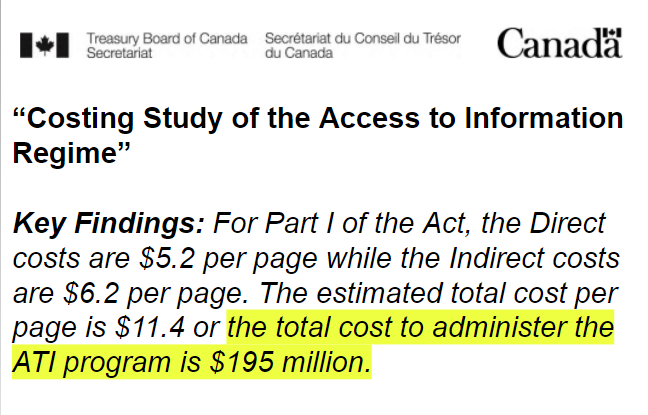
Funding is low.
Source: TBS
Real costs are not being met.
Source: SFU Morris J. Wosk Centre for Dialogue
A systemic breakdown in the availability of vital government information tears at accountability frameworks, accelerating a decline in Canadian trust in government institutions.
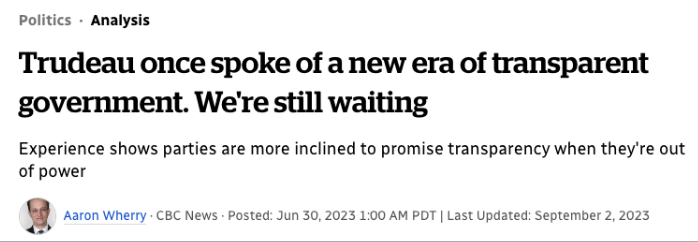
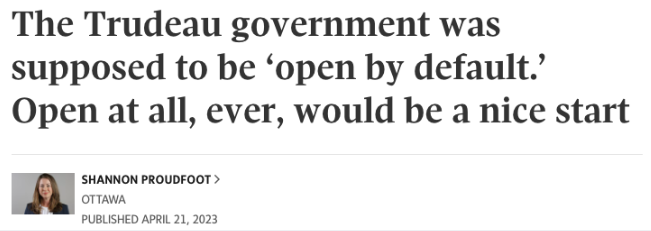
And the faltering system has wrought havoc on Canadian journalism, contributing to distrust and a plague of misinformation and disinformation fueled by the government itself.
Sources: CBC & The Globe and Mail
How did this happen?

Crisis of Transparency
A Report on The Dire St
Starting in the second half of the 20th Century, many countries started passing freedom of information laws.

Finland 1951

United States 1966


Denmark and Norway 1970

France 1971
In Canada, the provinces began to do so, too.

Nova Scotia 1977
New Brunswick 1977

Newfoundland and Labrador 1981

Quebec 1982
Source: CPAC
Next, it was the federal government’s turn…
In 1965, NDP MP Barry Mather introduced the first private member’s bill to pass a Canadian freedom of information law. It failed.
Source: TVO
In 1971, Progressive Conservative MP Ged Baldwin introduced the first comprehensive legislation in a private member’s bill.
It also failed.
Despite continued attempts throughout the 1970s to pass a law, there was no success. But Baldwin continued in his efforts to champion the need for a law.
A promising bill was introduced in the short-lived government of Joe Clark, but died before the government fell on a confidence motion.
Source: CPAC
Finally, under the Trudeau government’s last mandate, Secretary of State and Minister of Communications Francis Fox introduced a bill in the House of Commons.
Source: CPAC
Although the bill eventually passed, it did not look promising at first. After its introduction, the bill languished in committee.
The bill initially made it possible for the Information Commissioner and the courts to review exemptions for cabinet confidences. Prime Minister Trudeau made a last minute amendment completely excluding them from the reach of the bill.
Now when the government invokes a cabinet confidence, it is not subject to review even by the courts. It is the most restrictive type of cabinet secrecy among Westminster-style governments.
A confidential cabinet memorandum at the time:
It should be noted that
The bill also excluded the Prime Minister’s Office and the political staff of Ministers’ offices, omitting key parts of government from its reach.
The omission of cabinet confidences from the bill and the omission of key offices where government power resides was a bruising disappointment. It would undermine the efficacy of the law from its earliest years.
Finally, on June 28, 1982, the bill passed. It came into force the following year.
Sources: VoiceofBC and Canuck Politics
Despite the legislative requirement to study the law every five years, there has been minimal change to the law since it was passed, even as it has played a vital role in Canadian history over the last forty years…



For now, it has fallen on civil society actors to try and fix the system.

Parliament has left the task of fixing things to civil society, as no political party feels it has an incentive to create systems for more disclosure.
As recent history shows, every time a new government takes office, they pledge transparency. Once elected, such promises quickly fade. Instead of progress, there’s a consistent pattern of backtracking, leaving citizens disillusioned.
Source: Canuck Politics
In 2006, Stephen Harper was elected on a promise of greater transparency after the Sponsorship Scandal plagued the preceding government. His campaign platform promised vast changes to the access to information system. His first bill was entitled the Federal Accountability Act.
Conservative Party of Canada Federal Election Platform 2006
A Conservative government will:
Implement the Information Commissioner’s recommendations for reform of the Access to Information Act.
Subject the exclusion of Cabinet confidences to review by the Information Commissioner.
Oblige public officials to create the records necessary to document their actions and decisions.
Provide a general public interest override for all exemptions, so that the public interest is put before the secrecy of the government.
None of these promises received meaningful implementation.
Source: CPAC
Justin Trudeau burst onto the scene promising radical transparency. His first private member’s bill, the Transparency Act, promised a new era of radical transparency to build trust with citizens.
In 2015, the Liberal Party under Trudeau elected with promises of creating a transparent government.
Liberal Party of Canada Federal Election Platform 2015
A Liberal government will:
Make government information more accessible.
Make government data and information open by default, in formats that are modern and easy to use.
Ensure that Access to Information applies to the Prime Minister’s and Ministers’ Offices.
None of these promises received meaningful implementation.
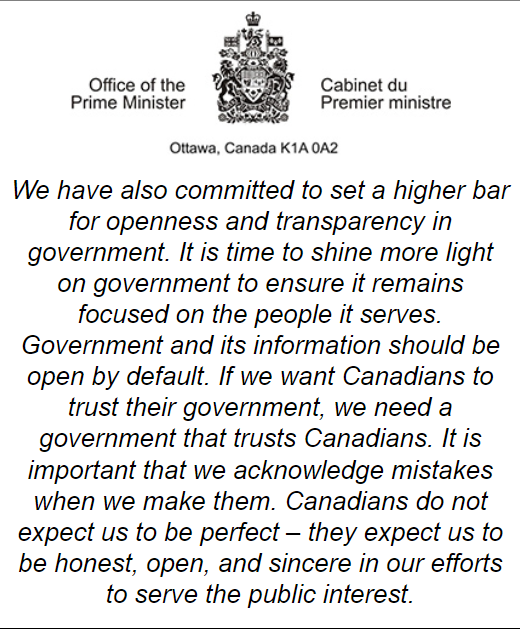
After his election in 2015, Prime Minister Justin Trudeau included language about government being “open by default” in all his mandate letters to cabinet ministers.
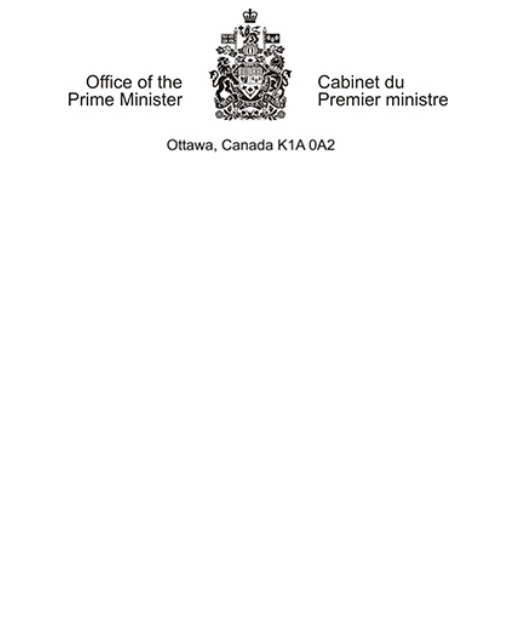
By 2024, that language was removed from the letters.